During the withdrawal process following Russia’s defeat in Syria, Alexander Dugin, an eccentric Russian nationalist “thinker” and one of the architects of Eurasianism ideology, threatened Turkey on social media and posted: “The end of Kemal’s Turkey has begun, we will do what we did not do, you will regret it, but it will be too late”. He then deleted the post after his big brothers in the FSB must have caught his ear, as he wrote: “Without the Russians in Syria, Erdogan will lose a very important ally and friend. We did a lot to help Erdogan during the tensions and the coup in 2015. Russia will not harm Turkey, but after this betrayal, it is difficult for Russia to come to Turkey’s aid.” Some circles in Turkey have tried to downplay Dugin’s statement by claiming that he is not taken seriously in Russia, that his party is marginalized and that he is seen as some kind of madman. But is Dugin really an insignificant and marginal figure who is hard to take seriously? The answer to this question should be sought in Dugin’s ideology, connections and the circles he serves before his personality.
In 1990, Dugin published his first work, The Paths of the Absolute, and a year later he founded his own publishing house and the association/organization “Arktogaia” that would become the center of his new intellectual and political networks. Arctogaia defines itself as follows:
ARCTOGAIA is a community of intellectuals studying the religious traditions, cultures and histories of the nations of the world. The association’s activities are focused on building stronger ties between the world’s religions and nations on the basis of a prehistoric primordial tradition, which is the common heritage of all humanity. Particular attention is paid to the traditional values of the peoples of the Eurasian continent. The way of life, beliefs, culture of Eurasia and the influence of these peoples on universal history are the focus of Arctogaia’s research. In addition, the association’s members also study the basic principles of social and political ideologies.
If you’ve ever wondered where the association’s name comes from, you only need to know that Guido von List and Jörg Lanz von Liebenfels, the founders of Ariosophy, which was a major inspiration for the occult origins of Nazism, associated the oldest homeland of the Aryans, Urheimat, with the lost polar continent “Arktogäa” (North-Gaia). Why and against what Dugin chose such a path we will discuss in this series of articles.
The Arktogeia manifesto lists how to challenge the modern world and the people at the center of this challenge. The names in Dugin’s first manifesto are very diverse and come from different backgrounds. René Guénon and Martin Heidegger, George Lukács and Ali Shariati, Nietzsche and Carl Jung are on the same list, for example.
Chaos Magic
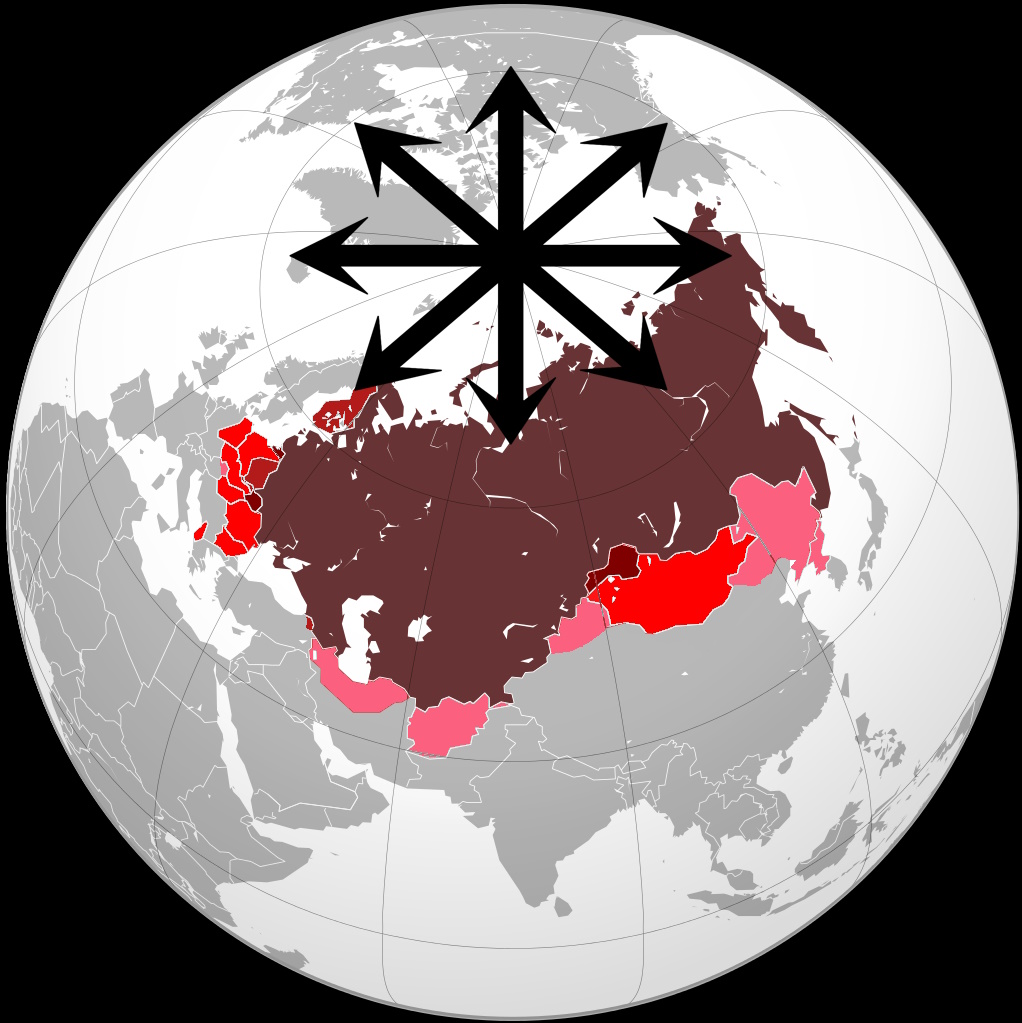
Dugin’s ideas were the basis for the creation of the Eurasia Party in 2002. I would also like to draw attention to the allegations that this party was partly financed at its inception by the FSB, the successor of the KGB. The flag of the Eurasian Party consists of eight white or yellow arrows on a black background with a pattern emerging from the center. This symbol is the so-called “chaos wheel” or “chaos star” in chaos magic.
For this reason, Dugin’s Eurasianism is considered a satanic cult. According to Dugin, chaos has replaced Logos, the biblical term for God, which means the Master Organizing Essence, but also the Word, and symbolizes order. For this reason, the symbol of chaos magic, which positions itself in opposition to the hegemony of the Subterranean, is the symbol of Eurasia. The claim that the age of Logos is coming to an end is also embedded in Dugin’s not-so-secular and deeply metaphysical doctrine, along with the idea that if we do not accept the transcendent ambitions of chaos and act accordingly and build the new order, we will be left under the rubble of the collapsed old order. Chaos against order, disorder against Logos.
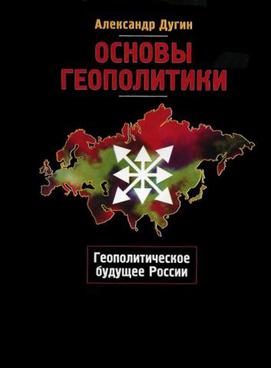
This denial of the West is at the same time a rejection of the ideologies that inspired the established Western order, or that were created and supported by it. For Dugin, Liberalism is an unacceptable source of absolute evil. He calls his eclectic and syncretic thinking the Fourth Political Theory or the Fourth Way. In essence, he argues that his far-right and even fascist views are a new, original and uniquely Eurasian ideology that takes the best of Communism, Nazism, traditionalism and Ecologism. For this reason, he also winks at a fascist revolution in Russia and sets as a goal for his followers the overthrow of the American Empire.
Dugin’s Eurasianism, which seeks great alliances in the region and propagates that it is an alternative, actually remains loyal to the goals of the Russian Empire and Soviet Imperialism. It would not be an exaggeration to call it a kind of postmodern Bolshevism. In this new version, the class struggle, the interests of the homeland and the inevitable and deterministic historicism of the materialist reading of history ascribing sanctity to sacred lands seem to have been transformed into an inevitable global conflict. When these views are combined with incorrigible Russian practicality and realism, they become reality on the ground, as we have witnessed closely over the last 20 years. The process that started with the invasion of Georgia and followed by the annexation of Crimea risks turning into a global nuclear war.
Is Dugin an Insignificant and Marginal Figure?
Dugin is not someone who has appeared out of nowhere and is trying to attract attention with his loud-mouthed rhetoric. In the 90s, he is known to have advised figures such as State Duma Speaker Gennady Seleznyov and Sergei Naryshkin, a key member of the ruling United Russia Party. The Naryshkin connection is important. Naryshkin, who became the head of the Russian Foreign Intelligence Service (SVR) in 2016 after serving as the head of the Russian Presidential Administration, must have been one of those who paved the way for Dugin. Dugin’s personal access to the Kremlin is another matter. There are some developments in recent years that suggest that high-level access has been restricted. But Kremlin access is part of his sphere of influence and perhaps the least important. If one looks closely, one can see the influence of his geopolitical vision on the Russian General Staff Academy and the Ministry of Defense. This is an influence that is more important than short-term political engagements and perhaps will last beyond Dugin’s lifetime. It is possible to see Dugin’s traces behind the moves in Georgia, Ukraine and Syria. The Russia-Iran cooperation is also different from the story of two countries in a difficult situation. Dugin attributes a special importance to Muslim societies and states and supports them to play an important role in Eurasianism.
On the other hand, his interest in the Turks is well known. Among his plans was to bring Turkey to Russia’s side and to strengthen the Turkish-Russian-Iranian front against the West through a structure similar to Pan-Turkism. It was this vision that inspired Hungarian President Viktor Orban to bring Hungary into the Organization of Turkic States as an Observer Member. This is not to say that Hungary has chosen a Duginist and Eurasianist path, but the literature of Eurasianism is the first source that those seeking an alternative to Western hegemony turn to. For historical reasons, Turkey pursues a strategic middle way policy with Russia, while at the same time winking at countries like Hungary through Turanism. As you can see, Dugin’s ideas resonate and are strategically used even in non-Russian circles.
Victims of Sacred Geopolitics
In this context, the Syrian front is not only important because of the possibility of Russia losing its energy hegemony over Europe due to Qatari gas coming from Syria. What makes Dugin angry enough to publicly threaten Turkey is that Syria has become a symbol of a war between the West and the East through proxies, and that this front has been lost in a major defeat. But on the other hand, Dugin is too stuck in his ideology to take into account that while Turkey is having problems with the US for many reasons and has become close enough with Russia to buy the S-400, Russia does not trust Turkey and is thinking so viciously that it will activate its air defense systems against a large-scale operation in northern Syria, opening up space for the PKK and thus the US. While Turkey did what it had to do in its own interest, Russia, which did not make any concessions for 13 years and martyred 33 Turkish soldiers, saw the consequences of its all-for-me policy with this bitter experience.
Dugin is currently in denial. As we have mentioned in previous articles, Dugin’s Eurasianism, which is projected and dialecticized as the war between Apollo and Python, Atlantic and Arktogaia, Land and Sea, and built on Western and Hebrew eschalotogies, seems to have underestimated the independent Turkey that is charting its own path. Turkey is a dynamic country that has been able to adopt the good values of the West through the modernization process while changing its shell in order not to lose its essence. It is not and should not be a direct recipient of synarchic or occult ideologies and their symbolism. Dugin understands Eurasianism through his ideological filter of Islam and Tengrism, which he presents as a primordial monotheism for Pan-Turkism and which he claims is compatible with Abrahamic religions. Turkey’s deep cultural heritage lends itself well to developing views on these questions that better suit the Turkish people. When this is not done, we are forced to play someone else’s game.
In this short article, we have seen that the seemingly marginal, esoteric, conspiratorial Dugin Eurasianism’s attempts to bring about the end of history and the apocalypse with the order that will emerge from chaos and to triumph over the Western Logos can create a sphere of influence that will shape the reality on the ground, and that the influence of Dugin’s ideas goes far beyond his influence as a person. Dugin is a doomsayer. He does not hide it. We will look at the Christian Messianic ideas and Jewish mysticism in the background of his thinking, especially the influence of Kabbalah and many other esoteric inspirations in the next article in the series and much more. As you look behind what you are being told, you will be disturbed by what you will see, but once you pull back the curtain, it is useless to close it. Here, we will pull back a part of that curtain and shed light on the ideas and structures that shape the world we live in, in the context of current developments in our region and the world.